Software for print shops: quotes and job orders without recalculating
In a print shop every job is different: format, paper, inks, run length, finishing. We build the software that calculates the quote with your shop’s rules and, if the customer accepts, turns it into a job order that leaves no doubt on the press.
1How quotes are done today
A request comes in: a thousand leaflets, double-sided, coated paper, folded as a trifold. Whoever quotes opens the usual spreadsheet, looks up the paper price, works out sheets, press time and finishing, and adds a margin. If the customer wants three run lengths compared, it is done three times.
That spreadsheet is usually understood by one or two people. When they are away, quotes are delayed, and when paper prices change, nobody knows how many cells need updating.
2From quote to press
When the customer accepts, the second problem begins: turning what was quoted into a job order. Details get lost there that later cost money:
- A finish that was in the quote and never reaches the job order.
- Customer files in different versions, sent by email and by file transfer, with nobody sure which is final.
- Proofs approved over the phone, with no record of who signed them off.
- Jobs invoiced below what they cost because nobody compared plan with actual.
3What we build
We move into software the rules that today live in the spreadsheet and in your team’s experience:
- A quote calculator with your papers, presses, make-ready times, finishes and margins, comparing several run lengths at once.
- A job order generated from the accepted quote, with every specification and the approved version of the artwork.
- A single place to receive customer files, with version history and recorded proof approval.
- Tracking of each job by stage (prepress, printing, finishing, delivery), visible to the shop floor and to the office.
- A comparison between what was quoted and what was actually used, to tune the rules with data.
4Where to start
Almost always with the quote, because it is what repeats most and what depends on fewest people. We go through a dozen real jobs with whoever quotes, write down the rules they use and check that the system gives the same figures as their spreadsheet before changing anything.
A person always decides the final price: the system proposes, shows the breakdown and allows adjustments. Once the calculator is trusted, the job order and tracking follow.
5What we have already built
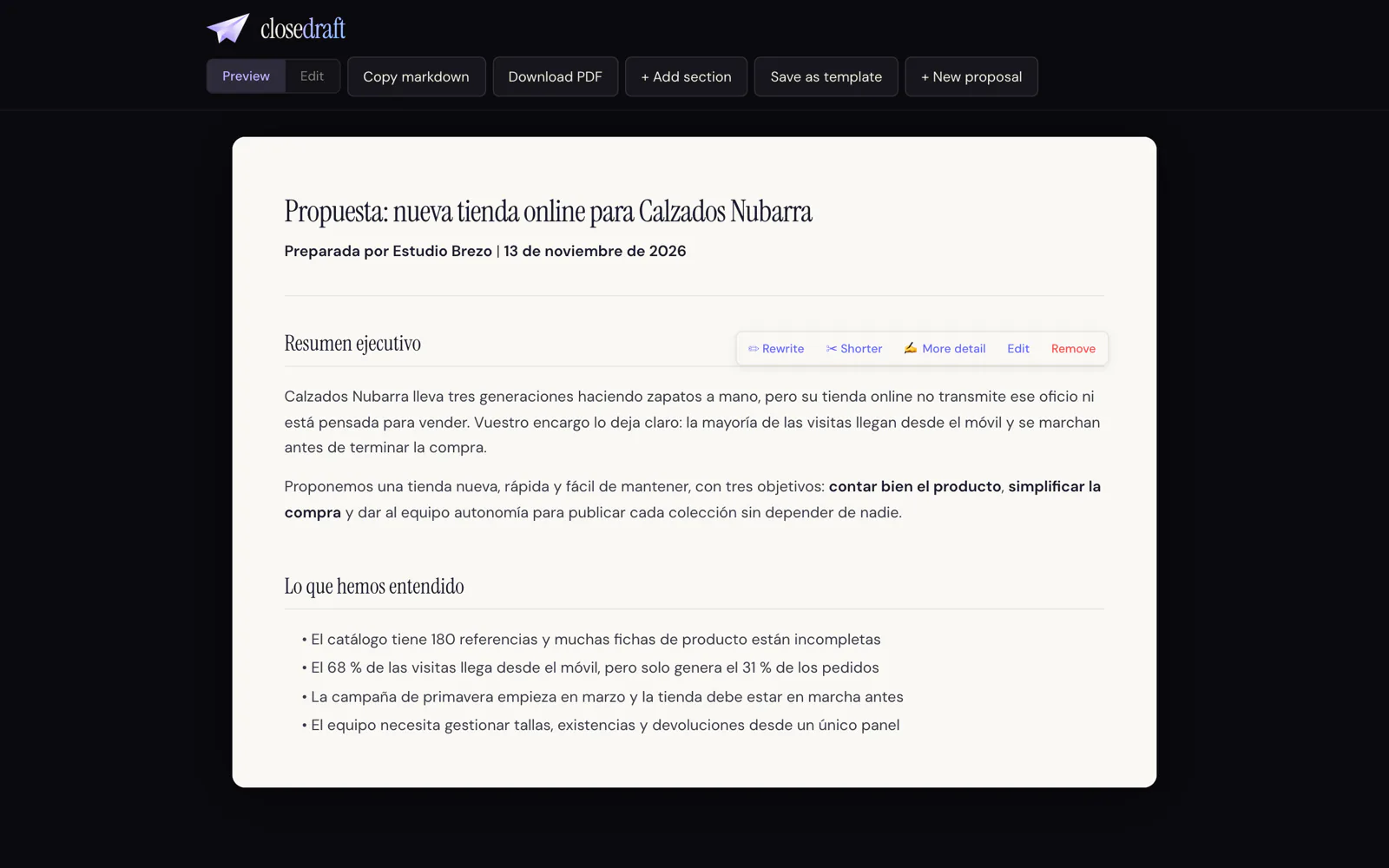
Closedraft
From a client’s brief to a professional proposal in PDF
Closedraft turns a client’s brief into a professional proposal in PDF. It is the same idea as a print quote produced from rules and presented without being redone by hand. It is a prototype, and we do not yet have a published case in printing.
Prototype
6Frequently asked questions
Can we keep using our spreadsheet in the meantime?
Yes. The new system runs alongside it until we have checked, with real jobs, that both give the same figures.
Can customers request quotes online?
It can be done for the most standard jobs. For complex ones we usually have the system prepare a draft that a person reviews before sending it.
Does it connect to our invoicing software?
If your software allows data to be exchanged, yes. We check during the diagnosis and, if it is not possible, explain the alternatives.
How much does it cost?
We do not publish prices or timelines. They depend on how many costing rules your shop has and the connections needed. After the diagnosis we give you a fixed proposal.
Bring us your quoting spreadsheet
With the spreadsheet you use today and a few real jobs we can tell you which part of the costing can move into a system and what you would gain.
Tell us your problem