Software for clinics: appointments and patient contact without missed calls
A small clinic loses patients over something as simple as not replying in time. We build the system that answers, books the appointment and leaves your team what really needs a person.
1How it works today
In most clinics the front desk does three jobs at once: it looks after whoever is standing there, answers the phone and replies to the WhatsApp messages that pile up during the day. The diary lives in a practice management program, a spreadsheet or a notebook, and every appointment means checking free slots, confirming with the patient and writing it down by hand.
In the afternoon come the messages nobody could answer in the morning. Some patients have already booked somewhere else.
2Where hours and patients are lost
The problems repeat from one clinic to the next:
- Questions answered ten times a day: opening hours, the price of a first visit, the address, whether an insurer is accepted.
- Appointments given over the phone and never confirmed, leaving empty slots in the diary.
- Out-of-hours messages answered the next day, when the patient has already decided.
- Changes and cancellations that arrive through one channel and never reach the diary.
3What we build
An assistant that answers on WhatsApp with your clinic’s information: services, practitioners, opening hours and booking rules. It answers common questions, offers free slots, books the appointment and confirms it to the patient. If your clinic takes payment in advance for some consultations, it can take it within the conversation.
We do it in phases. First we study how each request arrives today and which questions repeat. Then we connect the assistant to the diary you already use, if it allows it, or give it a diary of its own. Finally we test it with real conversations before letting it talk to patients.
4What stays with your team
The assistant gives no clinical advice and does not interpret symptoms. Any health question, any complaint and any case that does not fit the rules goes to a person, who can take over the conversation at any time and see everything said before.
Health data is a special category of personal data. We design the system with that in mind from the start: what is asked, what is stored, where, and who can see it. We review it with you and, if your clinic has a data protection adviser, with them.
5Where it comes from
Kiero
An AI employee on the business’s WhatsApp
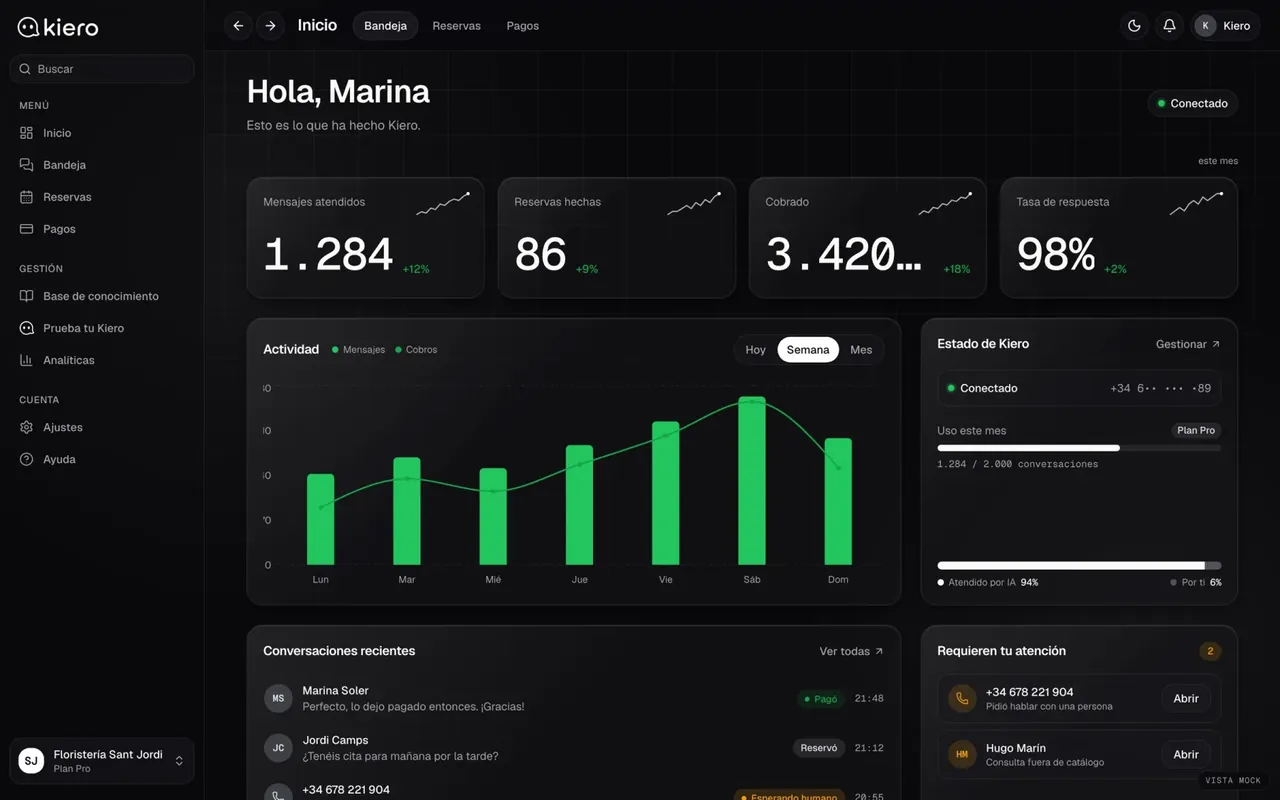
We do not yet have a published clinic client. The core piece is already built: Kiero is an AI employee in the business’s WhatsApp that answers customers, books appointments and takes payment within the chat, using each business’s catalogue and opening hours. When a question needs a person, it hands it over. It is live at kiero.es.
Live at kiero.es
6Frequently asked questions
Can the assistant give medical information?
No. It answers about services, opening hours and appointments. Health questions go to a person on your team.
Does it work with the practice software we already use?
That depends on whether your software allows a connection to its diary. We check during the diagnosis; if it cannot be done, we propose a diary of its own and explain what that involves.
What if a patient wants to talk to a person?
They ask, and the conversation passes to your team with the full history in view. Anyone on your team can also step in without being asked.
How much does it cost and how long does it take?
We do not publish prices or timelines. They depend on your diary, your channels and what needs connecting. We give you fixed figures after the diagnosis.
Tell us how appointments reach you today
From that we can tell you whether an assistant saves you work or whether the problem lies elsewhere.
Tell us your problem