Software for renovation companies: quotes, site work and invoices
A company that renovates homes and shops lives on quoting well, buying on time and billing for what was actually done. We build the software that joins those steps, so nobody has to rebuild them from phone photos and loose sheets.
1A small trade with a lot of paperwork
This page is about the company that refits kitchens, bathrooms, whole flats or commercial premises, with its own crew and trusted subcontractors. It is not the contractor that bids for public tenders, which we cover on another page, nor the large project with monthly progress billing to a developer.
A typical renovation goes through the same stages, and each one usually lives somewhere different:
- The itemised quote, built in a spreadsheet or in a program only one person really knows.
- The customer’s acceptance, sometimes on WhatsApp, sometimes signed on paper.
- Material orders: tiles, sanitaryware, joinery, with delivery dates that shape the job.
- Site records and photos, on the site managers’ phones.
- Changes the customer asks for halfway through, which are almost never recorded as a new quote.
- The final invoice, the stage invoices and, months later, the after-sales calls.
2Where the money leaks
It rarely leaks in the original quote. It leaks in what happens afterwards: a tiling change nobody added, material bought twice, a tradesman’s hours not charged to any job, or an extra the customer agreed verbally and disputes at the end.
The other problem is the owner’s time. If every quote starts from scratch and every customer question means scrolling through a phone, evenings go on paperwork instead of visiting jobs and winning new ones.
3What we build
We start from a real, finished job: its quote, its purchases, its site records and its invoice. That shows us where the plan and the reality drifted apart, and we propose short phases, each useful on its own:
- Itemised quotes built from your own price list and measurements, with versions when the customer asks for changes.
- Sign-off of the quote and of every extra on a phone or on the web, so there is a record of what was asked for.
- Material orders tied to each job, showing what was ordered, what arrived and what is missing.
- Site records from the phone, with hours, photos and notes that reach the office the same day.
- Quoted versus spent on every job, and stage and final invoices without retyping the items.
- An after-sales log: what was claimed, on which job and who sorted it.
4What a person always decides
The system does not set prices or accept extras for you. It suggests from what you have quoted before, flags when a job drifts and records every change with its author and date. If you already use invoicing or accounting software, we normally connect to it rather than replace it.
5What we have already built that resembles it

Closedraft
From a client’s brief to a professional proposal in PDF
Closedraft turns a client’s brief into a professional proposal in PDF. It is a prototype, not a product in use, but it covers the quoting part: generating the document from data instead of laying it out by hand. We do not yet have a published case with a renovation company.
Prototype
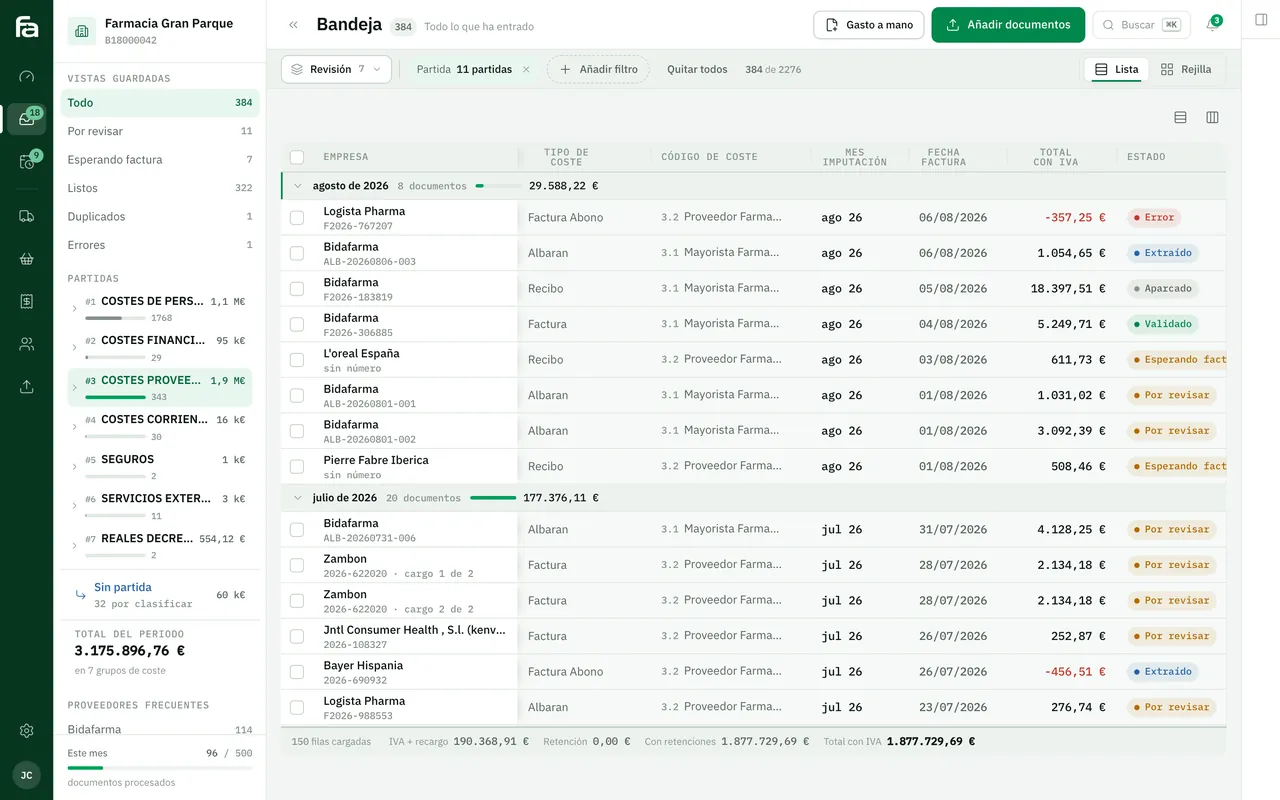
Farmacta
A pharmacy’s back office, built on its paperwork
Farmacta reads suppliers’ delivery notes and invoices and checks them against what was ordered. It is the same job as checking that the material your builders’ merchant invoiced is what actually reached the site.
In use at its first pharmacy
6Frequently asked questions
How is this different from off-the-shelf quoting software for builders?
Off-the-shelf software works well if your way of working fits it. Custom software makes sense when the quote, the purchases, the site records and the invoice sit in different places that nobody joins up, or when your price list and the way you measure do not fit the tool.
Will my site managers have to learn a complicated program?
They should not. On site people work from a phone with little time, so the field part is designed to be filled in within a couple of minutes: hours, photos and what is missing.
Does it also work for jobs with progress billing?
If you also work for developers or public bodies with monthly progress billing, that is covered on the job costing and progress billing page. Both parts can live in the same system.
Can we start with quotes only?
Yes. Many companies start there because that is where most hours go each week. Purchasing and site records can come in a later phase.
How much does it cost?
We do not publish prices or timescales. After the assessment we give you a fixed-scope proposal.
Show us a finished job
With the quote, the purchases and the invoice of a real renovation we can tell you where the margin slips away and which phase to do first.
Tell us your problem