Verifactu for companies invoicing in Spain from their own software
Many subsidiaries and foreign companies issue their Spanish invoices from their group’s system or from their own platform. If that system falls under Verifactu, it has to be adapted, and the decision is often made far from Spain. This guide explains what changes in that particular case.
1The essentials in a nutshell
Verifactu is the Spanish regulation on computerised invoicing systems: every invoice issued with a program must leave a record that cannot be altered without it showing, with a hash chained to the previous one and a QR code on the invoice. It applies to any system that issues invoices, whether off-the-shelf or in-house. The full explanation, with what it requires and how a program is adapted, is in our main Verifactu guide.
Whether your company is within scope depends on its tax position in Spain, and that is not for us to decide. Among others, businesses that keep their VAT books through the Immediate Supply of Information system (SII) are outside it. Confirm it with your tax adviser and on the Spanish Tax Agency’s website before changing anything.
2What changes when the system belongs to the group
In a Spanish SME, the invoicing program usually sits in the same office as the invoice. In a subsidiary it often does not: head office runs the system, half the world uses it and nobody wants to change it for one country’s rules. That raises questions a local company never faces:
- Who the producer of the system is: the regulation requires a statement of conformity from whoever produces it, and it must be put in writing whether that is head office, the software vendor or whoever does the adaptation.
- Where the records are created: inside the group system, or in a Spanish layer that receives each invoice and generates the record, the hash and the QR code before it is issued.
- How corrections are made: the manual fixes head office used to make afterwards are no longer allowed without leaving a trace.
- Which mode suits you: sending each record to the Tax Agency as it is created, or keeping them signed and chained in the system.
3Three common routes
Adapting the group system, when head office accepts changes for Spain and someone can maintain them. Adding a Spanish layer that connects to the group system and handles only what the regulation requires. Or issuing Spanish invoices from a local program connected to the central system, which keeps receiving the data. Which one fits depends on how your system is built and who can maintain each piece.
4Deadlines: the dates in force and the announced delay
Under Royal Decree-law 15/2025, published in December 2025, the obligation would start on 1 January 2027 for companies paying Corporate Income Tax and on 1 July 2027 for everyone else. We checked this in secondary legal sources, not in the official text. In October 2026 the Ministry of Finance announced its intention to delay it to October 2028; until that change is published in the Official State Gazette (BOE), the 2027 dates still apply. For a group deciding from abroad, it is wise not to take the delay for granted.
5What we have already built around invoices
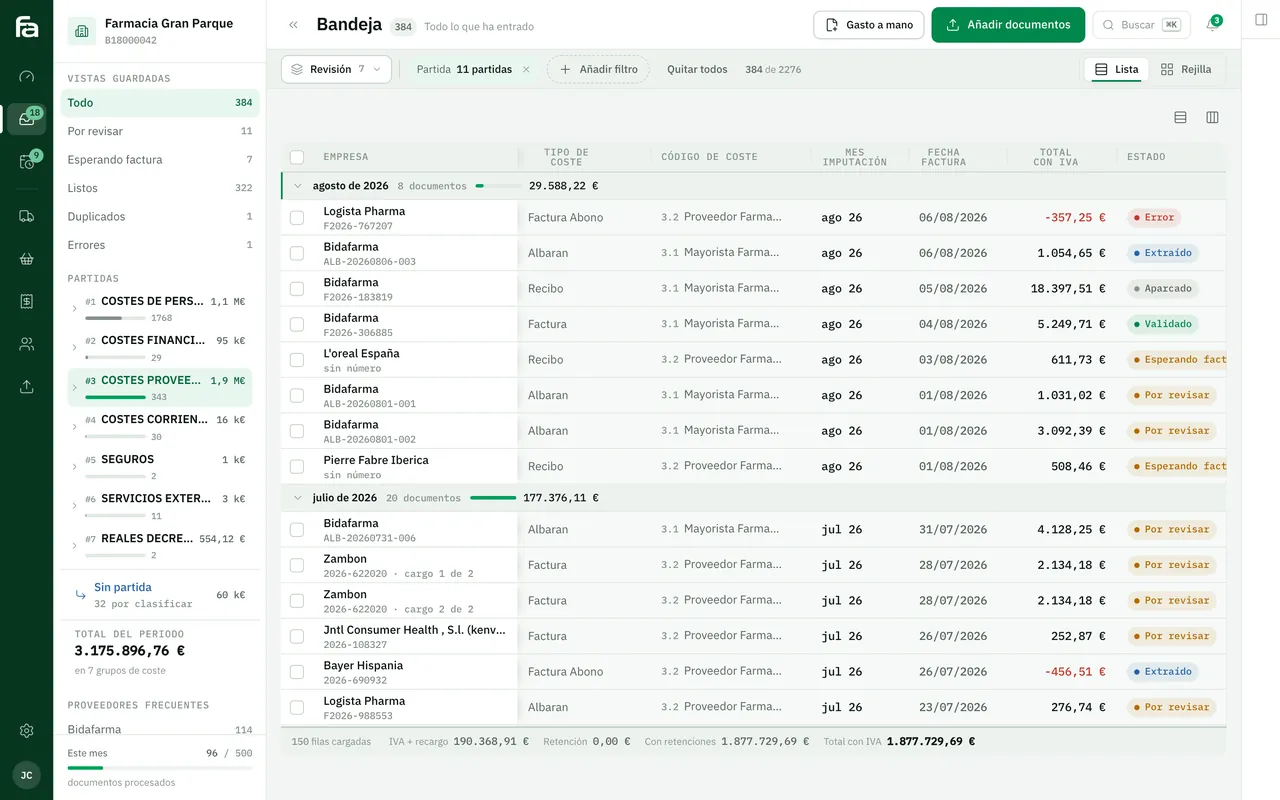
Farmacta
A pharmacy’s back office, built on its paperwork
Reads supplier invoices and delivery notes in PDF and flags what does not match. It works with received invoices, not issued ones, but demands the same care with every figure. In use at its first pharmacy. We have no published case with a foreign company.
In use at its first pharmacy
6Frequently asked questions
Does Verifactu apply to a foreign company invoicing in Spain?
It depends on its tax position in Spain, which your tax adviser or the Spanish Tax Agency must confirm. If it applies, the regulation covers the system you issue invoices with, even if it is your group’s.
Do we have to change head office’s whole ERP?
Not necessarily. Sometimes a Spanish layer connected to the group system, generating the records and the QR code, is enough. We look at it in the diagnosis.
Has Verifactu been postponed to 2028?
The Ministry of Finance has announced it, but until it is published in the BOE the dates in force are the 2027 ones from Royal Decree-law 15/2025. Check the timetable on the Spanish Tax Agency’s website.
Do you give tax advice?
No. We adapt the software following the regulation and its technical specification, and we document it. The tax interpretation belongs to your adviser and the Tax Agency.
Invoicing in Spain from your group’s system?
Tell us how your Spanish invoices are issued today and we will tell you what would need reviewing to adapt it.
Tell us your problem