Custom software: the pros and cons, without the sales pitch
People who sell custom software tend to mention only the upside. Here are the downsides too, because they are real, and what can be done to make them weigh less. If it does not pay off for you after reading this, better to know now.
1The advantages you actually notice
The main advantage is not technical: the software follows the way of working that gives your company its edge, instead of forcing you to change it to fit a product built for everyone. That shows in very concrete ways:
- No more workarounds: nobody copies data from one program to another or keeps a parallel spreadsheet for what the program does not handle.
- The right people get in, with the permissions they need, without a licence for everyone who only looks things up.
- It connects to what you already have, such as your accounting software or online shop, instead of replacing everything.
- It changes at your pace: if a pricing rule changes tomorrow, it changes in the software without waiting for a vendor’s roadmap.
2The disadvantages, plainly stated
Custom software carries costs and risks that an off-the-shelf product does not, or carries less of. They are worth facing before you start:
- Up-front investment: you pay for the build before you use it, whereas a packaged product is paid for as you go from the first month.
- Supplier dependence: if only one person or one company understands the system, you are in their hands.
- Maintenance: software is never finished. Bugs need fixing, components need updating and rules or the business will change.
- Scope risk: if it is not clear what needs building, the project grows, drags on and ends up solving something other than what was needed.
- Your team’s time: someone in the company has to spend hours explaining how the work is done and testing what is delivered.
3How those disadvantages are reduced
None of them disappears entirely, but all can be contained if they are agreed from the start. The investment is spread by building in short phases: each phase ends in something you test with your own data, and none starts without your approval of the previous one. You can stop at any point with something that already works.
Dependence is reduced by keeping the code, accounts and domain in your company’s name from day one, in writing, and by delivering documentation that would let another team carry on. Scope risk is reduced with an initial diagnosis and a closed-scope proposal that also says what is left out.
Maintenance is not reduced: it is planned. Always ask who will look after the system a year from now, and on what terms, before signing for the build.
4When it does not pay off
It does not pay off when an off-the-shelf product covers almost all of your process as it comes, when the process is not yet defined even on paper, or when nobody in the company can spend time deciding how the software should work. Nor when the aim is to save on accounting or invoicing, which standard products handle well.
If your question is whether to adapt an ERP or build alongside it, or whether to stay on spreadsheets or make the move, we have separate guides for each. Here we only wanted to put on the scales what hardly anyone mentions.
5Custom software already in use

Certero
Tender intelligence for public works
No management package recommends the bid discount for each tender from the awarding body’s history: that is why it was built to measure, with Certia Group. Live at certero.es.
Live at certero.es. Accepted into NVIDIA Inception.
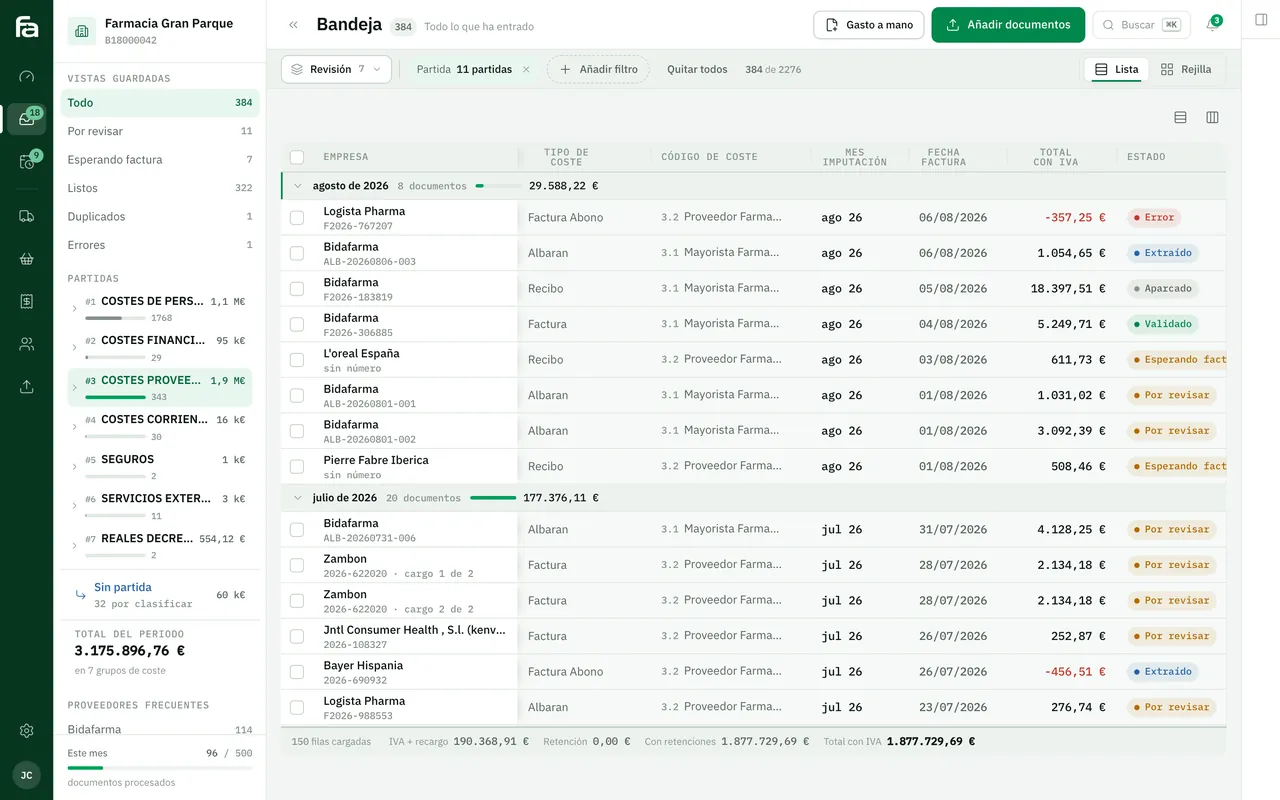
Farmacta
A pharmacy’s back office, built on its paperwork
One specific part of a pharmacy, reading delivery notes and invoices in PDF and turning them into due dates and cash flow, built to measure rather than as a do-everything program. In use at its first pharmacy.
In use at its first pharmacy
6Frequently asked questions
Is custom software always more expensive than an off-the-shelf product?
At the start, almost always. Over several years it depends on how many licences you pay for, how much adapting the packaged product costs and how many hours go into workarounds. We do not publish prices: we assess it after the diagnosis.
What happens if the supplier disappears?
If the code, accounts and domain are in your company’s name and there is documentation, another team can carry on. If they are not, the risk is high. Ask for it in writing before you start.
Do we always have to pay for maintenance?
Some maintenance is always needed, whether your supplier, your own team or someone else does it. What gets agreed is who does it and on what terms.
Can we start with something small?
That is what we recommend: start with the process that costs most hours, check that it works and then decide whether to extend it.
Does it pay off in your case?
Tell us which process costs you most hours and we will tell you frankly whether an off-the-shelf product would solve it better.
Tell us your problem