How to choose a custom software provider: questions and warning signs
Almost every provider gives a good presentation. The difference shows in the answers to a few concrete questions, and in what happens when you ask them to show you something that works.
1What you are really buying
Custom software is not bought like a packaged program: you commission a team that has to understand your operation, make decisions on your behalf for months and still be there when something breaks. That is why how the team works matters more than the list of technologies in its proposal.
The questions in this guide apply to any provider, including us. You do not need to know how to code to ask them; you do need to insist on concrete answers and be wary of vague ones.
2Six questions for the first meeting
Write the answers down and compare them across providers:
- Who will actually write the code for my project? Ask for names, or at least whether it is the same team that is selling to you or whether it is subcontracted, and to whom.
- What have you built that I can see working? A link to something in use is worth more than ten screenshots. Ask, too, what state each thing they show you is in.
- How do you deliver? The healthy answer is short phases that you test with your own data, with something usable at the end of each one.
- In whose name will the code, the hosting, the domain and the service accounts be? The answer that protects you is “in your company’s name”.
- How is it maintained afterwards? Who fixes a fault, how you report it, what counts as a correction and what as new work.
- What happens if we stop working together? What you are handed, in what format and with what documentation so someone else can carry on.
3Warning signs
None of them proves on its own that a provider is bad, but each one deserves a follow-up question:
- A fixed price before anyone has looked at your process or your documents. Without a diagnosis, the price was calculated for an imaginary project, and someone will pay the difference later.
- Everything in one final delivery. Months without seeing anything usable and, at the end, a system nobody on your team has tested with real cases.
- The provider’s own platform with no way out: your data and screens live in something only they can move, and there is no complete export.
- Answers that never get down to examples: “we adapt to anything”, “we are experts in every sector”.
- Nobody asks about the people who will do the work every day, or asks to see the awkward documents.
4How to compare two proposals
Do not compare only the total. Put them side by side and look at what each phase includes, what is explicitly left out, who on your side signs off each delivery and what happens if a phase does not work. A longer proposal is not a better one; one that is clear about what it will not do usually is.
If you can, ask each provider how they would handle the most awkward case in your process, the one that costs you most hours today. The answer says a lot about whether they have understood your business. What to put in writing is covered in our guide to the development contract.
5What we show when we are asked these questions
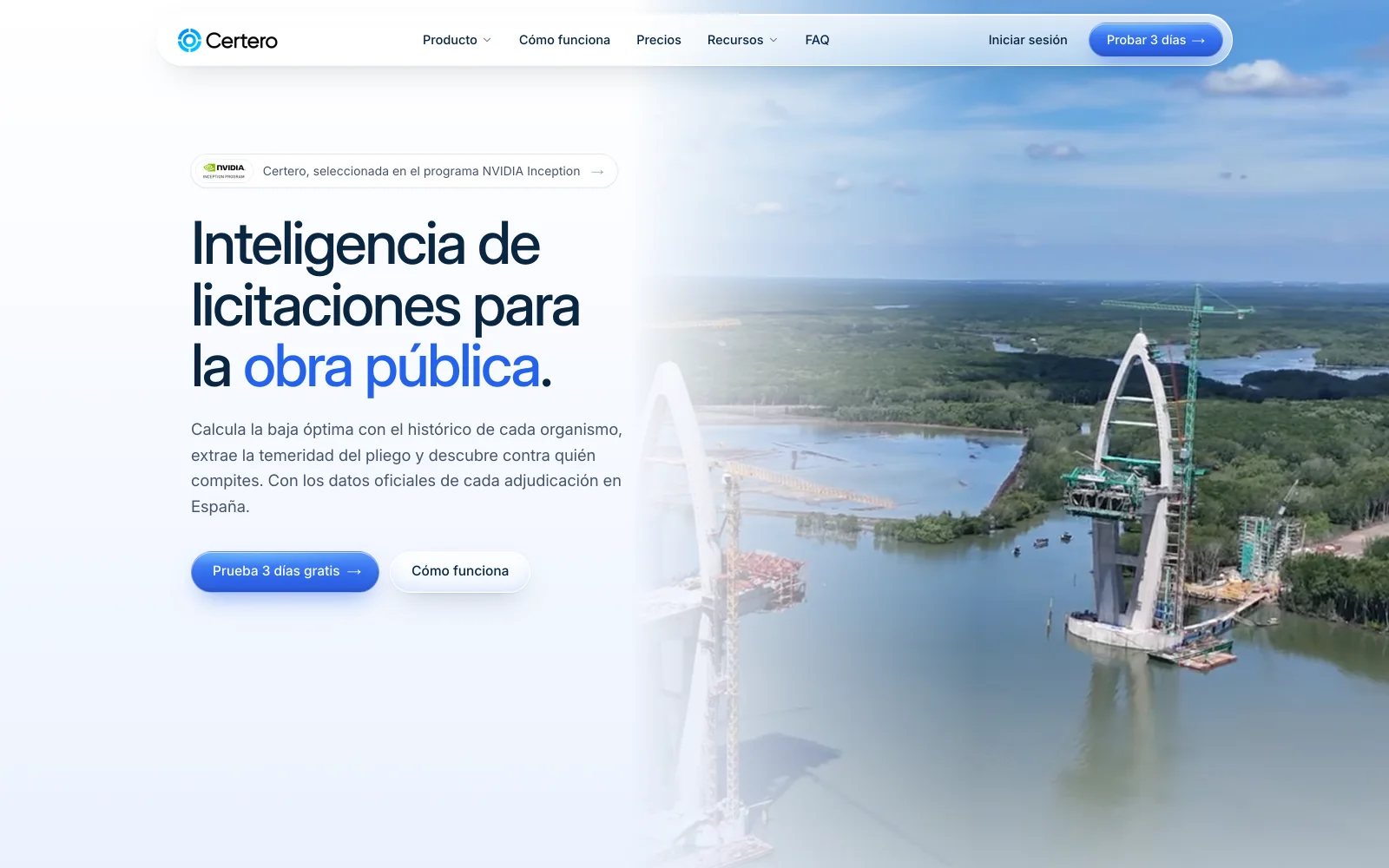
Certero
Tender intelligence for public works
A product you can open and use: it is live at certero.es. It is the first thing we show when someone asks what we have built that genuinely works.
Live at certero.es. Accepted into NVIDIA Inception.
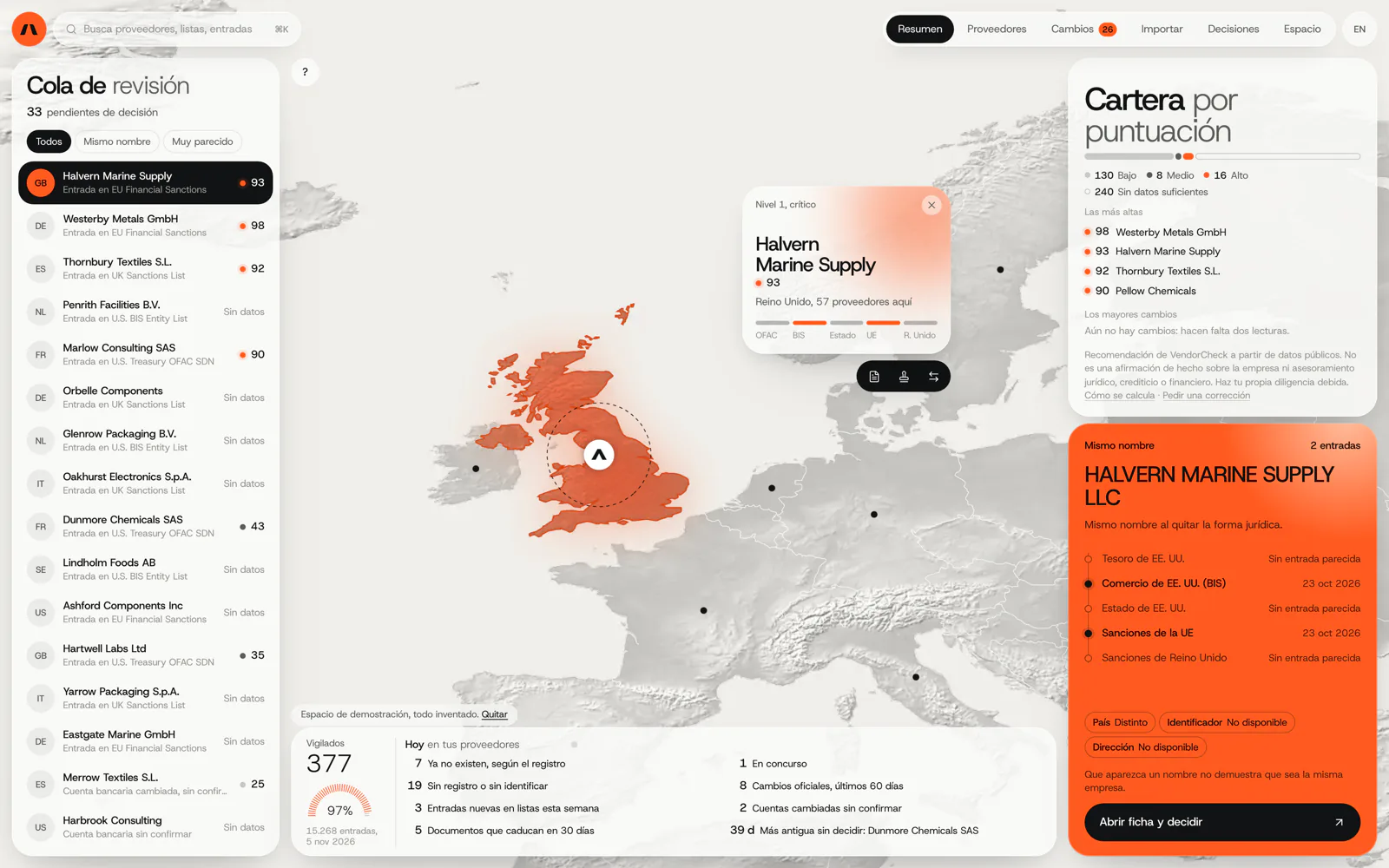
VendorCheck
Supplier screening against official sanctions lists
An example of why it pays to ask about status: it is in development. Matching against the official lists works; accounts, billing and alerts are coded and not yet connected, and the screens use invented data. That is how we describe it.
In development. Matching against the official lists works; accounts, billing and alerts are coded and not yet connected. The screens are shown with an invented demo workspace.
6Frequently asked questions
Is a large provider better than a small one?
Size matters less than knowing who will work on your project and whether it will still be the same person a year from now. With a large team, ask who you will get; with a small one, ask what happens if that person is away.
Should I ask for client references?
Yes, and better still, see something working. If the provider cannot name clients for confidentiality reasons, ask at least for a demonstration with test data and the real status of what they show you.
What if the provider uses its own platform?
Ask how you would export all your data and what would happen to the screens and rules if you left. If the answer is that you cannot, you will know the cost of leaving before you join.
How many quotes should I get?
Two or three are enough if you compare them with the same questions. Beyond that, time goes on meetings and the differences that matter are already visible.
Ask us these same questions
We will answer in writing, with names, with what you can see working and with the real status of each thing.
Tell us your problem