Custom software or an off-the-shelf ERP? Criteria for choosing well
It is one of the first questions any company faces when it wants to put its management in order. The honest answer is that an ERP is often the right choice, and that custom software makes sense for one specific part of the business, not all of it.
1The real question: how close is your process to the standard?
An ERP is built for what almost every company does the same way: accounting, invoicing, purchasing, payments in and out, basic stock, tax. In those areas the way you work looks very much like the company next door’s, and the program brings years of solved cases that new development would take a long time to match.
The question only arises when part of your operation does not fit: your own pricing calculation, a particular way of planning site work or production, a control your sector requires that the program does not cover. Before comparing programs, split the business into two lists: what you do like everyone else and what you do your own way, and where in that second list money is at stake.
2Five criteria for comparing
None decides on its own. Use them to ask specific questions of whoever presents each option:
- Fit with the standard: if the ERP covers almost all of your process out of the box, the balance tips towards it.
- Cost of adapting the ERP: configuration and development on top of an ERP is still programming, and it must be maintained through every vendor update. Ask how much of what you need is configuration and how much is development.
- Per-user licences: many ERPs charge per person or per module. Think about how many people will need to log in, including those who only look things up or close a task, and how that number will grow.
- Dependence on the implementation partner: with many ERPs, changes can only be made by an authorised reseller. Ask what happens if you stop working with them.
- Ownership and exit: with custom software the code can be yours; with an ERP the information is yours, and you should know in what format you can take it out.
3When the ERP is the right answer
If your edge is not in how you invoice, keep the books or run the warehouse, there is no point building that from scratch. A well-known ERP comes with an accountant who already knows it, updates when tax rules change and a market of professionals who can use it.
It is also the answer when the company is small, the process is loosely defined or nobody has time to decide how a new program should work. In those cases we will tell you so, even if it means there is no work for us.
4The mixed route, which is the most common
In practice many companies end up with both: the ERP for accounting, invoicing and tax, and custom software for the part that sets them apart, connected to the ERP through its API or exchange files. Customers, items and invoices live in the ERP; your own process lives in the custom application, which reads from or writes to the ERP as needed.
That way you do not duplicate what the ERP already does well, you do not pay ERP licences for people who only use your own part, and the distinctive part can change at the pace of the business. The condition is that the ERP has a documented way to read and write data; our integration pages explain what each program offers, such as Sage, a3, Holded or Odoo.
5Software for the part no standard program covered
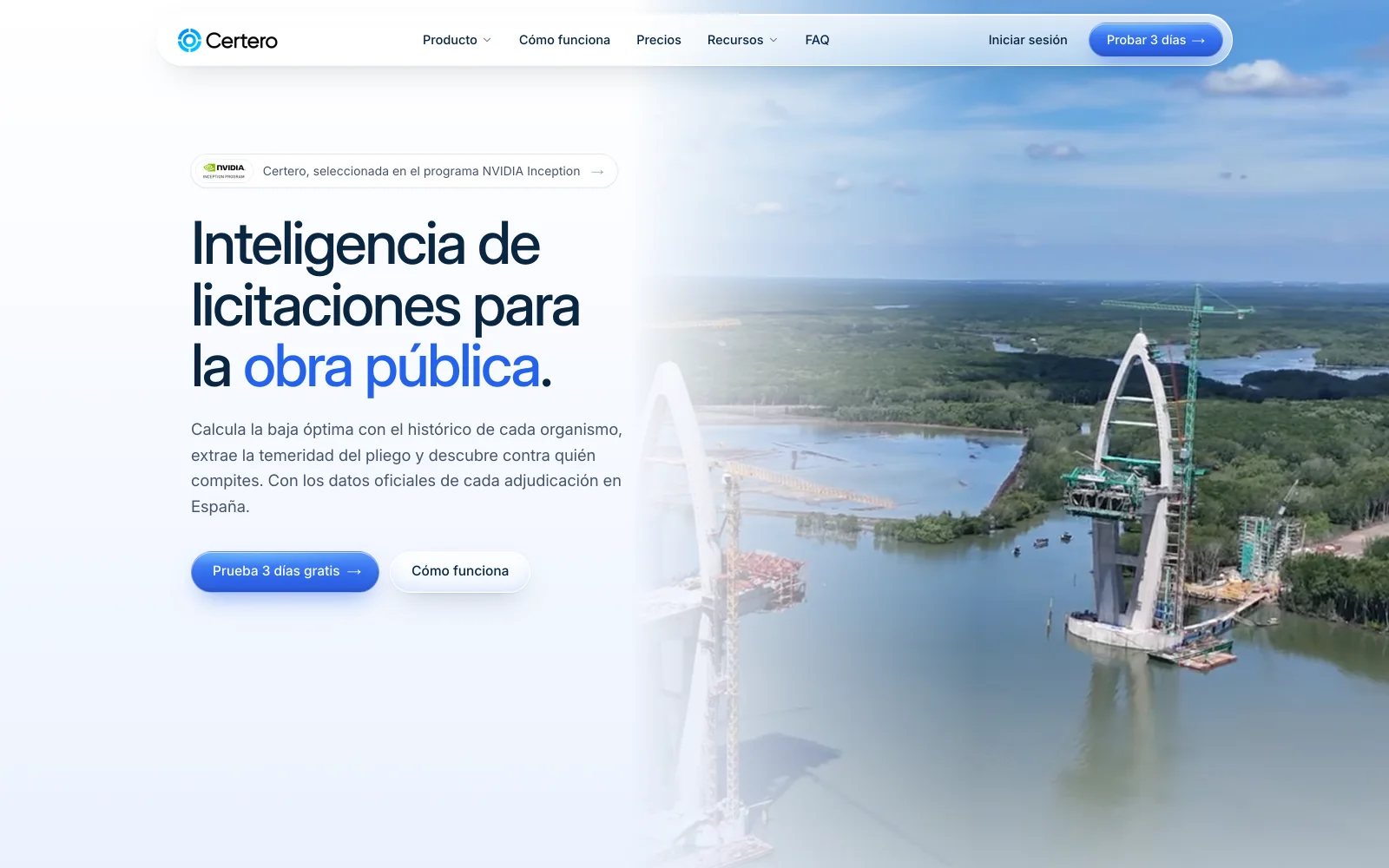
Certero
Tender intelligence for public works
No management package recommends the bid discount for each tender from the authority’s award history, so Certero was built from scratch, with Certia Group. Live at certero.es. It does not replace a contractor’s ERP and is not connected to one.
Live at certero.es. Accepted into NVIDIA Inception.
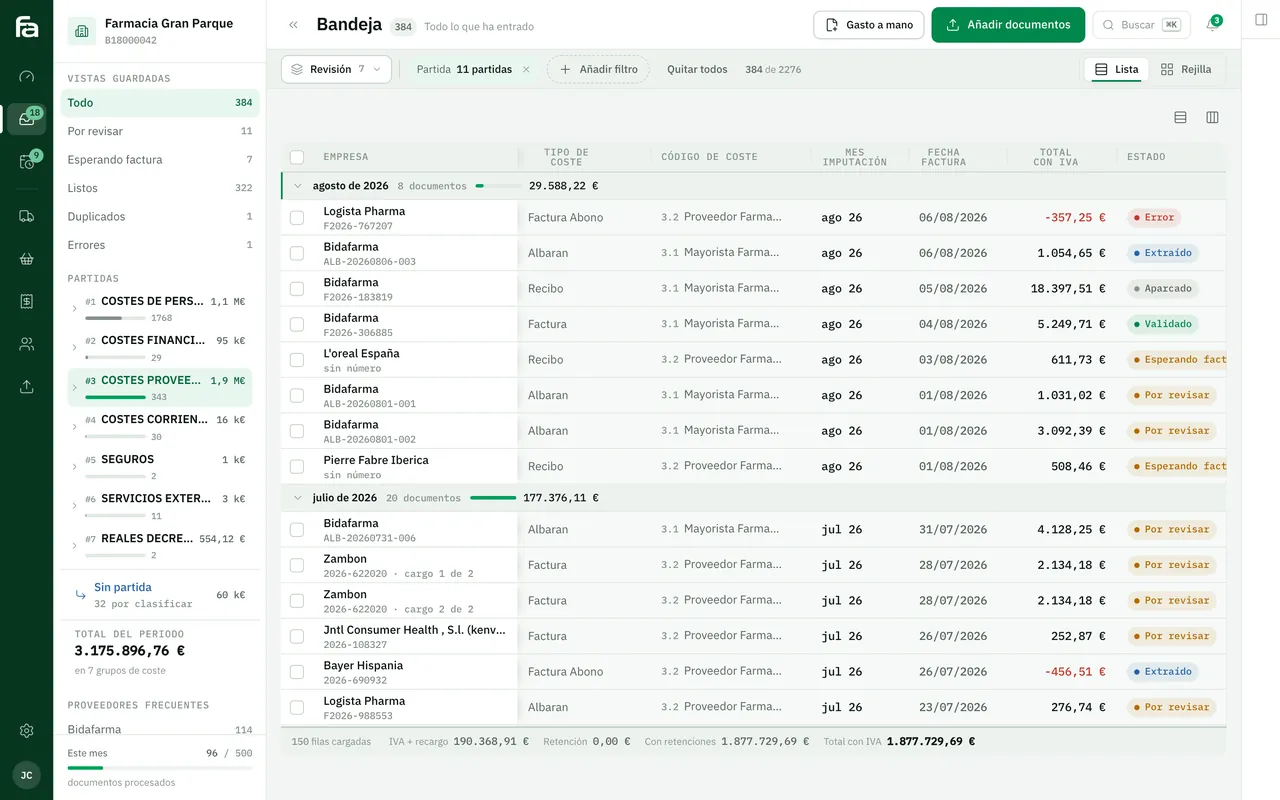
Farmacta
A pharmacy’s back office, built on its paperwork
Farmacta handles one specific part of a pharmacy: reading delivery notes and invoices as PDFs and producing due dates, cash flow and analytics from them. In use at its first pharmacy. We do not yet have a published case of connecting to an ERP.
In use at its first pharmacy
6Frequently asked questions
Isn’t a heavily customised ERP the same as custom software?
It is similar in cost and risk, with one difference: the customisations depend on the ERP version and on the partner. If almost everything is customisation, it is worth comparing with building only that part and connecting it.
Can you connect our ERP to a custom application?
If the ERP has an API or a documented way to exchange data, yes. We are not a certified partner of any vendor, and the first thing we do is check what your specific version allows.
Which part should always stay in the ERP?
Accounting, invoicing and anything with tax obligations. There the ERP and your accountant already carry the regulatory changes.
We already have an ERP and it falls short. Should we switch?
Not necessarily. Before a full migration, check whether what is missing is a specific part that can live outside and be connected.
Torn between adapting your ERP and building alongside it?
Tell us what your company does its own way and we will tell you what we would leave in the ERP and what, if anything, we would build.
Tell us your problem