Business-to-business e-invoicing in Spain: what it means and why a PDF will not do
Many people think they already issue e-invoices because they email PDFs. For the obligation coming between businesses, that is not the case. Here are the terms and how they differ from what you already know.
1What it is, in plain terms
An e-invoice, in the sense of the new obligation, is a structured file: each item of data (tax ID, taxable base, VAT rate, due date) sits in its own field, so the customer’s software reads it without anyone typing it in. A PDF is a tidy picture of an invoice; a person understands it, but software has to guess where everything is.
The obligation between businesses and professionals comes from Law 18/2022 on the creation and growth of companies (the «Crea y Crece» Act) and is developed by Royal Decree 238/2026, published in Spain’s Official State Gazette on 31 March 2026. Besides issuing and receiving in a structured format, it provides for reporting the status of each invoice, such as when it is paid.
2Three things that get mixed up
- B2B e-invoicing: about the format in which an invoice travels from your company to your customer’s.
- Verifactu: about how your software records each invoice it issues so that it cannot be altered without a trace. A different regulation with a different timetable.
- FACe and public-sector invoicing: if you invoice a town council or a ministry, you have been required for years to do so in Facturae format through an entry point such as FACe. It is the closest precedent, but it does not cover invoices between companies.
3Formats and channels
Structured format: the regulation relies on the European EN 16931 model and accepts several syntaxes, including UBL and Facturae. You do not need to choose the syntax yourself, but your software must be able to produce and read at least the one you agree with your customers.
Public solution and private platforms: the Spanish Tax Agency offers a public e-invoicing solution, regulated by Order HAC/1028/2026, and private platforms can also be used. Example: a garage invoicing an insurer can send from its own software through a platform, and the insurer receives it without typing anything.
Timetable: according to the Tax Agency’s website, the order came into force on 6 October 2026 and the deadlines run from that date: twelve months for businesses whose turnover exceeded 8 million euros, twenty-four for everyone else. Always check it on the Tax Agency’s website or with your adviser, because these timetables have moved before.
4When it matters and what to ask
It matters if you invoice from your own or a heavily customised program, or if you receive many supplier invoices that are typed in by hand today. Before changing anything, ask:
- Can our software produce and read a structured format, or only PDF?
- Will we use the public solution or a private platform, and who connects it?
- How will the payment status of each invoice be reported?
- What about invoices created elsewhere: the online shop, the point of sale, a job-costing program?
5The closest thing we have built
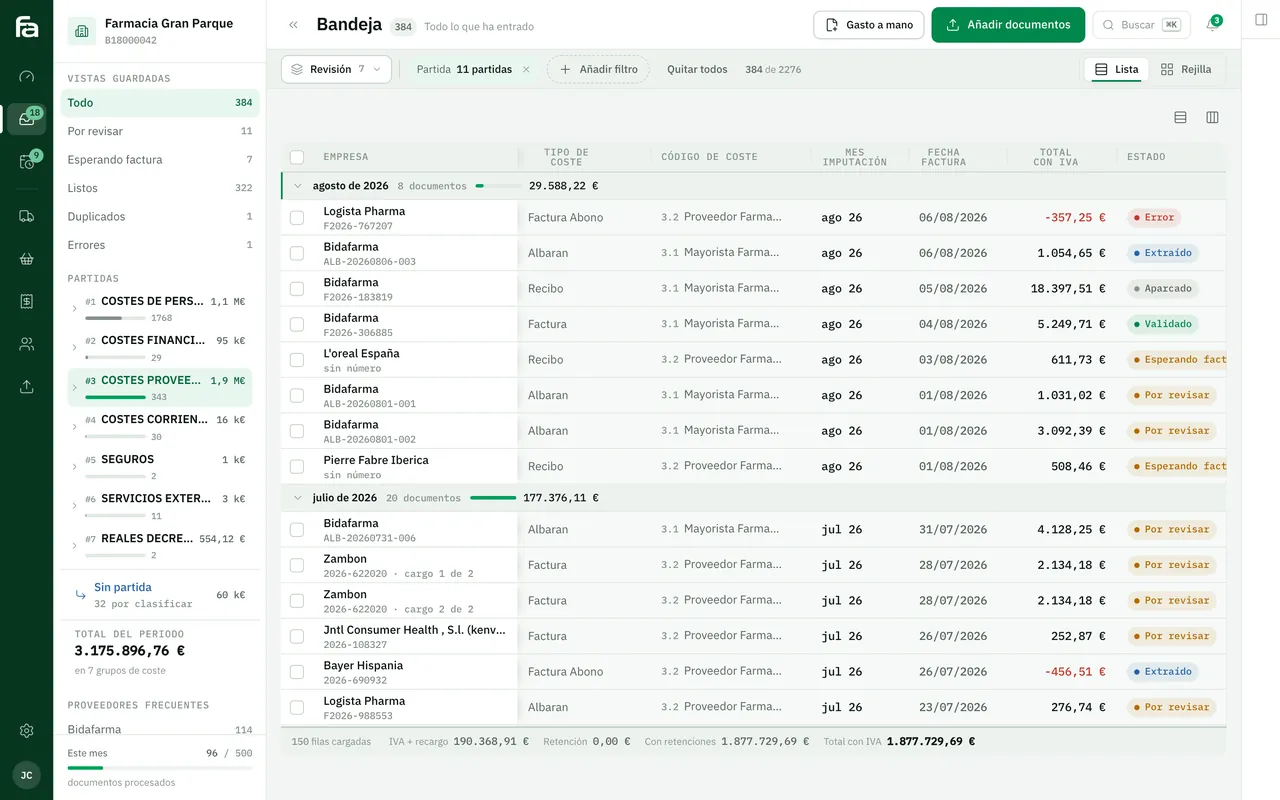
Farmacta
A pharmacy’s back office, built on its paperwork
Today it reads PDF invoices and delivery notes from wholesalers and laboratories and extracts their lines for a person to review. That is exactly the work a structured invoice would make unnecessary; we have not yet connected any e-invoicing platform. In use at its first pharmacy.
In use at its first pharmacy
6Frequently asked questions
If I email my invoices as PDFs, am I already compliant?
For the business-to-business obligation, no: a structured format is required. The regulation provides a transition period in which larger companies send a PDF alongside the structured invoice, but a PDF alone does not replace the e-invoice.
Does it affect me if I only sell to consumers?
The obligation concerns invoices between businesses and professionals. If you only sell to consumers, ask your adviser how it applies, as there are nuances depending on the activity.
Are e-invoicing and Verifactu handled by the same software?
Usually, yes, but they are two separate adaptations. It is worth planning them together so the same program is not reworked twice.
What is Facturae?
A Spanish structured invoice format, the one used to invoice public authorities. It is one of the accepted syntaxes, alongside UBL and others.
Can you connect my software to a platform?
Yes, it is an integration job like any other. We are not partners of any platform; we work from the documentation each one publishes.
Can your software only produce PDFs?
Send us a sample invoice and tell us where it is issued from. We will tell you what the structured format would require.
Tell us your problem