Corrective, evolutive, adaptive and preventive maintenance: how they differ
Software is not finished on the day it is delivered. Bugs appear, regulations change and new screens are needed. Each has a name, and it is worth knowing which ones are included in what you pay for.
1Four words, four kinds of work
Names vary a little between providers, but this is the most common split:
- Corrective: fixing what does not work as agreed. For example, the monthly report counts credit notes twice, or a button does nothing on mobile.
- Adaptive: adjusting the program to an outside change without changing what it does. A new phone operating system, a management system that changes how it connects, or a regulatory change such as the Spanish Verifactu invoicing records.
- Preventive: work users never see that prevents problems. Updating dependencies with known security flaws, checking that backups actually restore, watching server space or certificate renewals.
- Evolutive: adding or changing features. A new screen for the warehouse, an extra field on the order or a report that did not exist before.
2Where the line falls
The classic argument is whether something is a bug, usually included, or an improvement, usually charged separately. If the program calculates shipping by weight because that is what was asked for, and you now want it by volume, that is evolutive, even if day to day it feels like a fault.
That is why it helps to record at delivery what the program does and how it was checked. Adaptive work is the most common grey area: agree in advance who takes on the work when something changes that neither side controls.
3How it is usually contracted
There is no single formula. The most common are:
- A warranty period after delivery, during which corrective fixes are not charged.
- A recurring fee covering corrective and preventive work, with a defined scope.
- A bank of hours drawn down by evolutive requests, one at a time.
- A quote per request, with no fixed commitment, for programs that change little.
4What to ask before signing
- What counts as a bug, and who decides if we disagree?
- What are the response and resolution times by severity, from a system that is down to a minor annoyance?
- Through which channel and during which hours do we report issues?
- Are dependency and server updates included?
- Who covers a change in the law or in the system we connect to?
- Do I receive a monthly log of what was done?
- If I stop paying for maintenance, does the program keep working, and can I take it elsewhere?
5Software we keep running

Certero
Tender intelligence for public works
Live at certero.es. It is where we have learnt most about maintaining a model in production: what works, what needs watching and what should always stay in a person’s hands.
Live at certero.es. Accepted into NVIDIA Inception.
Kiero
An AI employee on the business’s WhatsApp
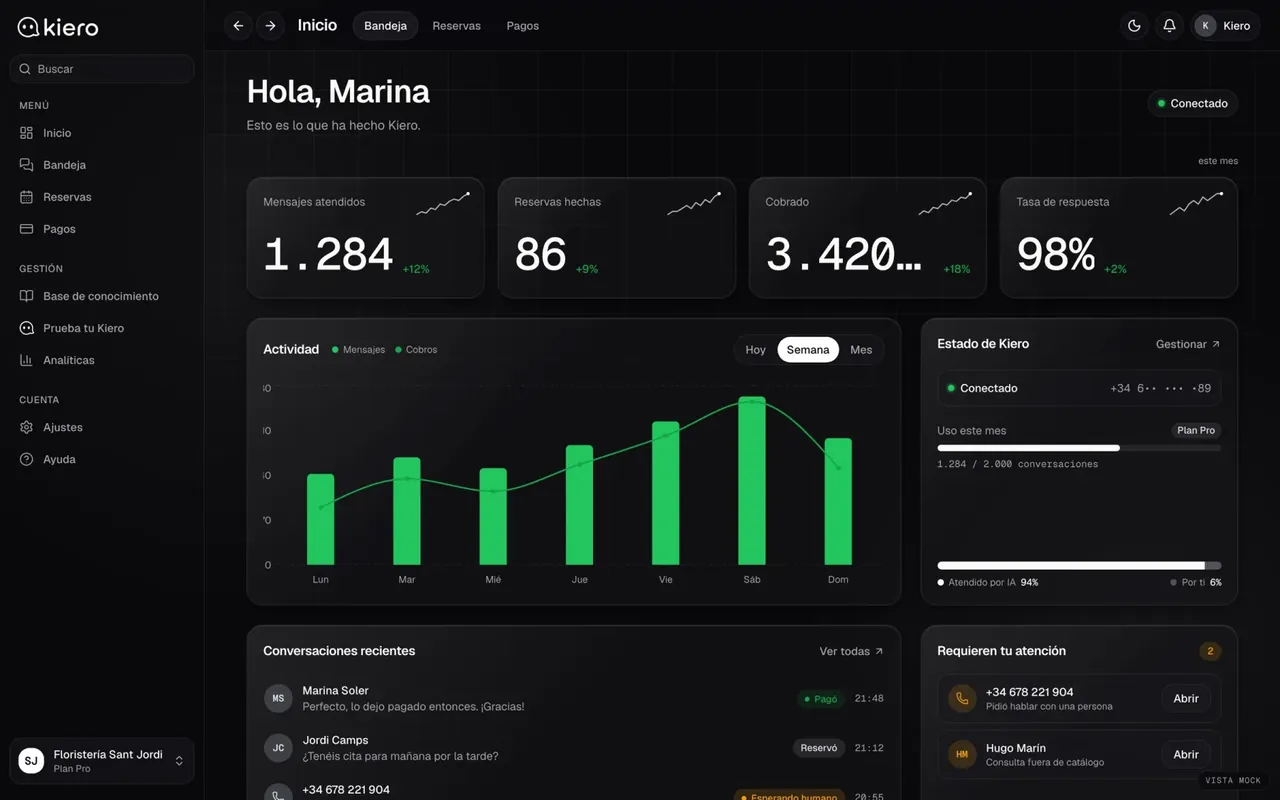
Our own product, which we maintain ourselves. It depends on WhatsApp and Stripe, so every change in those services means adaptive work. Live at kiero.es.
Live at kiero.es
6Frequently asked questions
Do I have to take out maintenance?
No. But a program with no preventive maintenance builds up outdated dependencies and known security flaws. If you do not contract it, at least agree who keeps an eye on things and who raises the alarm.
What is the difference between response time and resolution time?
Response time is how long it takes to acknowledge the report and start looking at it. Resolution time is how long it takes to fix it. They are separate commitments, and the contract should state both.
Can a different company maintain it from the one that built it?
Yes, if it has the source code, the documentation and the access. That is why code ownership and maintenance go hand in hand.
Is a change one of my customers asks for corrective or evolutive?
Almost always evolutive: the program did what was agreed and now something else is wanted. The sensible thing is to estimate it separately before doing it.
Do you have a program nobody looks after?
Tell us what it does and what it is built with. We will tell you what kind of maintenance it needs and whether it makes sense for us to take it on.
Tell us your problem