CRM: what it is and when a customer spreadsheet stops being enough
CRM stands for customer relationship management. It is where everything that happens with each customer and each prospect is written down, before, during and after a sale.
1The company’s sales memory
A CRM stores contacts, companies, conversations, proposals sent and next steps. Its value is not the list of names, which fits in any spreadsheet, but the history: who spoke to whom, what was promised, when to call back and why the last proposal was lost.
Here we cover the concept. The sales follow-up process, step by step, is on our page about sales CRM and proposal follow-up.
2An example: an air-conditioning installer
An air-conditioning firm with three sales staff receives enquiries through its website, by phone and on WhatsApp. Each salesperson notes site visits in a notebook or on their phone. When one goes on holiday, nobody knows which quotes were pending or who they promised to ring on Thursday.
With a CRM, each enquiry comes in as an opportunity with its source, the visit is logged with photos and measurements, the quote is sent from there and the system reminds you to follow up after seven days. The manager sees how many proposals are open and for how much without asking anyone.
3Signs that you need one
- Proposals are lost because nobody followed up in time.
- A customer’s information is scattered across emails, phones and notebooks.
- When a salesperson leaves, the customer relationship leaves with them.
- You do not know which channel brings the customers who end up buying.
4CRM, ERP, diary and WhatsApp
The ERP starts when there is an order: stock, delivery note, invoice. The CRM works before that, with opportunities that may come to nothing, and after, with the customer you want to keep. A diary or WhatsApp store conversations but not status: they do not know a proposal is pending or warn you if it is forgotten.
There are very complete off-the-shelf CRMs, and many ERPs include a CRM module. A custom CRM only makes sense if the way you sell is particular: technical site visits, measurements, public tenders or long sales with many people involved.
5What to ask before rolling one out
- Who will enter the data and at what point in the day? If it is a chore, nobody will.
- Does it connect to my email, my website and my management software?
- Can I export the full history if I change tools?
6Where we have worked on customer contact
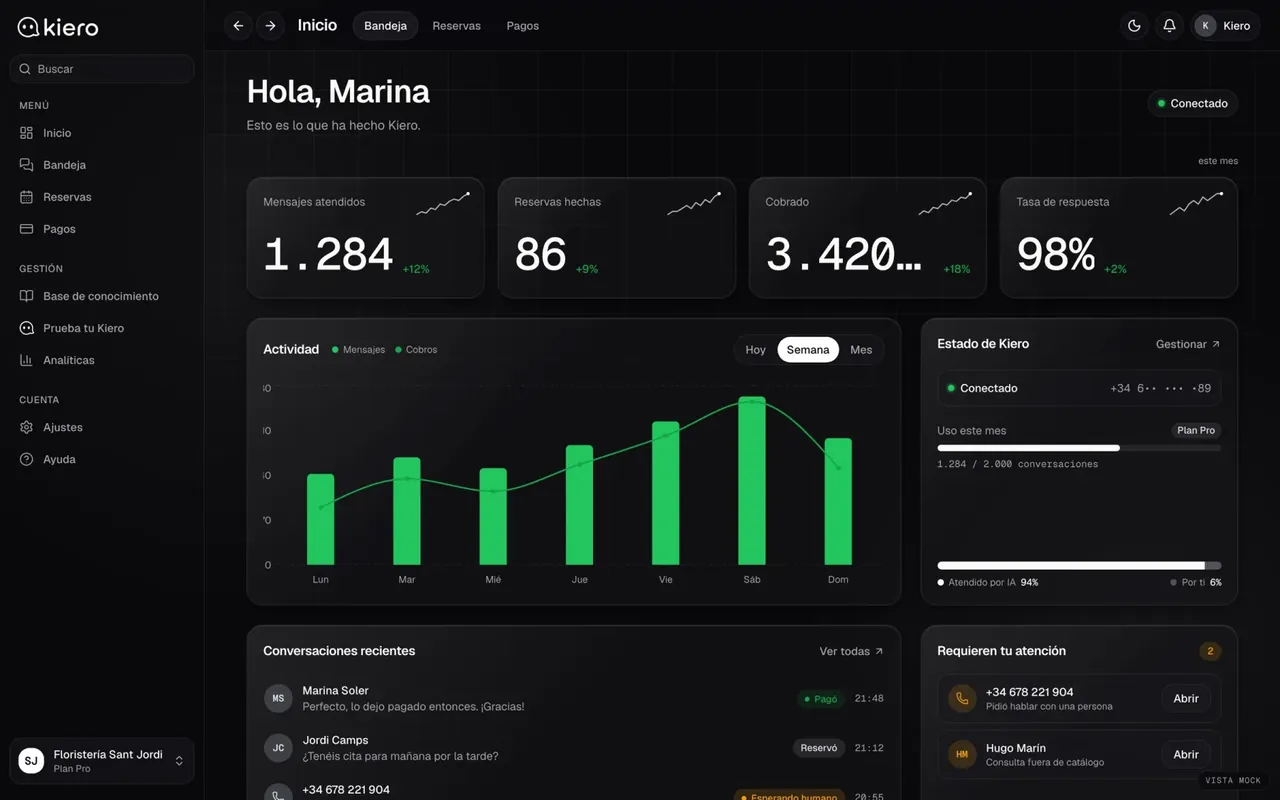
Kiero
An AI employee on the business’s WhatsApp
Kiero is not a CRM: it answers a business’s customers on WhatsApp, books appointments and takes payment, and hands to a person whatever needs a person. It handles the first-contact stage that then feeds any sales history. Live at kiero.es.
Live at kiero.es
7Frequently asked questions
Can a shared spreadsheet work as a CRM?
It works while one person does the selling and follow-ups are few. Once there are several people and dates to remember, a spreadsheet does not remind anyone or record who changed what.
Does the CRM need to be connected to the ERP?
It helps. Otherwise the customer record is duplicated and the salesperson cannot see unpaid invoices. At least customers and orders should flow between them.
Can it log WhatsApp conversations?
Some CRMs can, through WhatsApp’s official business platform. It depends on the product and on how you use WhatsApp today.
Why don’t sales staff use it?
Almost always because entering data costs them more than it gives back. A good CRM asks for few fields and fills itself from what already arrives by email, web form or phone.
Where are your proposals getting lost?
Tell us how a customer comes in and what happens until they sign. We will tell you whether an off-the-shelf CRM is enough or whether something of your own is worth building.
Tell us your problem