Electronic signatures: simple, advanced and qualified, with small-business examples
Signing on a tablet, accepting a quote with a click and signing with a digital certificate are different things, even though all are called electronic signatures. Here are the three levels and what is worth keeping in each case.
1Where the three levels come from
The European framework is Regulation (EU) 910/2014, known as eIDAS, amended in 2024 by Regulation (EU) 2024/1183. It distinguishes three levels of signature. None is invalid just for being electronic; what changes is how easy it is to prove, in a dispute, who signed and that the document was not altered afterwards.
2The three levels, one by one
- Simple signature: any electronic data a person uses to sign. A click on «I accept» at the foot of a quote, a typed name or a ticked box. It is valid, but if the customer denies accepting, you will have to prove it by other means.
- Advanced signature: uniquely linked to the signer, able to identify them, created with means under their control and tied to the document so that any later change is detectable. Example: a handwritten signature on a tablet that also records the stroke, the time and a code sent to the signer’s mobile.
- Qualified signature: an advanced signature made with a qualified certificate and a qualified device, such as the Spanish electronic ID card or a certificate from a trust service provider. The regulation gives it the same legal effect as a handwritten signature.
3Evidence: what actually protects you
In practice, a signature is worth as much as the evidence behind it. A sound process keeps, alongside the signed document:
- The exact version of the document, with a hash that shows it has not changed.
- Who signed and how they were identified (email, mobile code, certificate).
- Date and time of each step: sending, opening, signing.
- A log that cannot be edited later, not even by an administrator.
4Three small-business examples
Accepting a quote: for a small refurbishment, a simple signature with good evidence is usually enough in practice. For a large amount, it is worth raising the level.
Signing an employment contract: more is at stake, and your employment adviser should tell you which level they expect. Many companies use advanced or qualified signatures.
Signing for completed work on a tablet: the technician shows the job sheet and the customer signs with a finger. If the stroke, time, location and locked job sheet are kept, it comes close to advanced; if only an image of the signature is kept, it stays simple. How to set up that process is covered on our page on document signing and sign-offs.
5A related case, with caveats
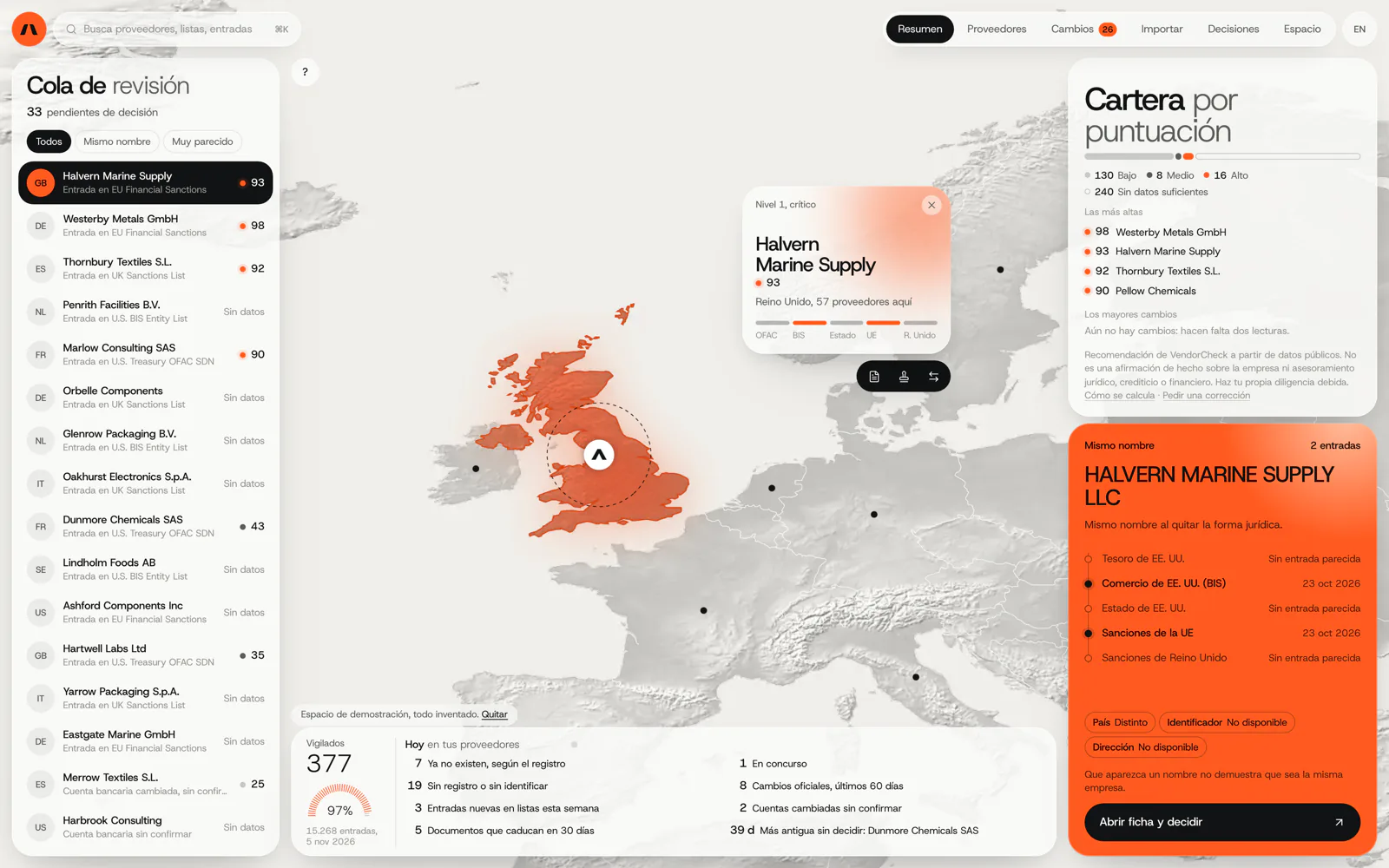
VendorCheck
Supplier screening against official sanctions lists
It does not collect signatures, but it tackles the same underlying problem: every decision about a supplier is logged with its source and date so it can be proved later. We do not yet have a published electronic-signature case. In development.
In development. Matching against the official lists works; accounts, billing and alerts are coded and not yet connected. The screens are shown with an invented demo workspace.
6Frequently asked questions
Is a click on «I accept» valid?
The regulation does not allow it to be denied effect merely for being electronic, but in a dispute you will have to show it was that person. That is why the evidence you keep matters.
Is a picture of a signature pasted into a PDF an electronic signature?
At most a simple one, and among the easiest to challenge: it leaves no proof of who added it or whether the document changed afterwards.
Do I need an external signing service, or can it be built into our software?
Both are possible. A qualified signature usually requires a trust service provider; simple and some forms of advanced signature can be built into your own application.
Which level do I need for each document?
It depends on the document and the risk, and it is a decision for your adviser. We build the process for the level decided and keep the evidence.
Do your sign-offs end up as scanned paper?
Tell us which documents your customers or staff sign and when. We will suggest the signature level and the evidence worth keeping.
Tell us your problem