Preventive maintenance of your own machinery (CMMS), without relying on anyone’s memory
A machine that stops halfway through an order costs more than all its services put together. We build the system that knows when each machine is due, raises the work order in time and keeps a record of what was done.
1When the machine warns you, it is too late
In many plants maintenance lives in three places: the manufacturer’s manual in a drawer, a sticker on the machine with the date of the last oil change, and the maintenance manager’s head. While he is there, it works. When he is on holiday or production peaks, the preventive work is postponed and what arrives instead is the corrective kind: the breakdown, the stoppage and the urgent call to the manufacturer’s technician.
Here we mean the machines your company produces with: presses, compressors, ovens, forklifts, packing lines. If your business is inspecting customers’ equipment, such as fire extinguishers, that is on the maintenance and fire safety sector page.
2Three ways to decide when it is due
Not every task is scheduled the same way, and a good plan mixes all of them according to the manufacturer’s guidance and what your team has learned over the years:
- By calendar: the annual service of a forklift or the monthly clean of a heat exchanger, even if the machine has barely run.
- By running hours: changing a compressor’s filters every so many hours, which comes round sooner if the machine runs double shifts.
- By cycles or units: strokes of a press, shots of a mould or metres on a winder, read from the counter.
- By condition, where the machine allows it: a temperature, vibration or pressure crossing a threshold opens a work order.
3What to gather before you start
The system is only as good as its asset register. Before scheduling anything, each machine needs a unique code, its location, manufacturer, model and serial number, its commissioning date and how critical it is to production. Then each one gets its plan: which task, how often, how long it takes, whether the machine must stop and which spare parts it uses.
Spare parts deserve their own list. A bearing or a belt that takes weeks to arrive should have a minimum stock level, and the system warns when a planned work order is going to take it below that.
4An ordinary day with the system running
When a counter or a date reaches its point, the work order is raised automatically and appears on the technician’s list, on a phone or a workshop tablet, with its checklist, instructions and spare parts already reserved. If the task requires stopping the machine, the system suggests a slot and checks it with production before fixing it.
When closing the order, the technician records hours, parts used, photos and anything they noticed. All of that goes into the machine’s history: what was done, when and at what cost. Over time the figure that matters emerges: how much maintenance is preventive and how much corrective, and how many hours each machine has been down.
- Typical mistake: copying the manual’s plan as is and raising so many orders that nobody does them.
- Typical mistake: counters nobody reads, so hour-based plans never trigger.
5What the manager still decides
The system proposes; postponing a service, changing a plan or declaring a machine fit for use is decided by a person, with a record of who and why. The safety checks required by the manufacturer or by the applicable regulations are defined by your technical manager with your health and safety adviser; we turn them into steps that cannot be skipped, we do not interpret them.
6Pieces we have already built

Hopp
Internships for students, one swipe away
Hopp is a native iPhone app designed so each task takes a single gesture. That is the standard we apply to the technician’s work order: if closing it with dirty hands takes more than a few seconds, it will be left blank. Hopp has been submitted to the App Store and is awaiting review.
Submitted to the App Store in October 2026
Securacta
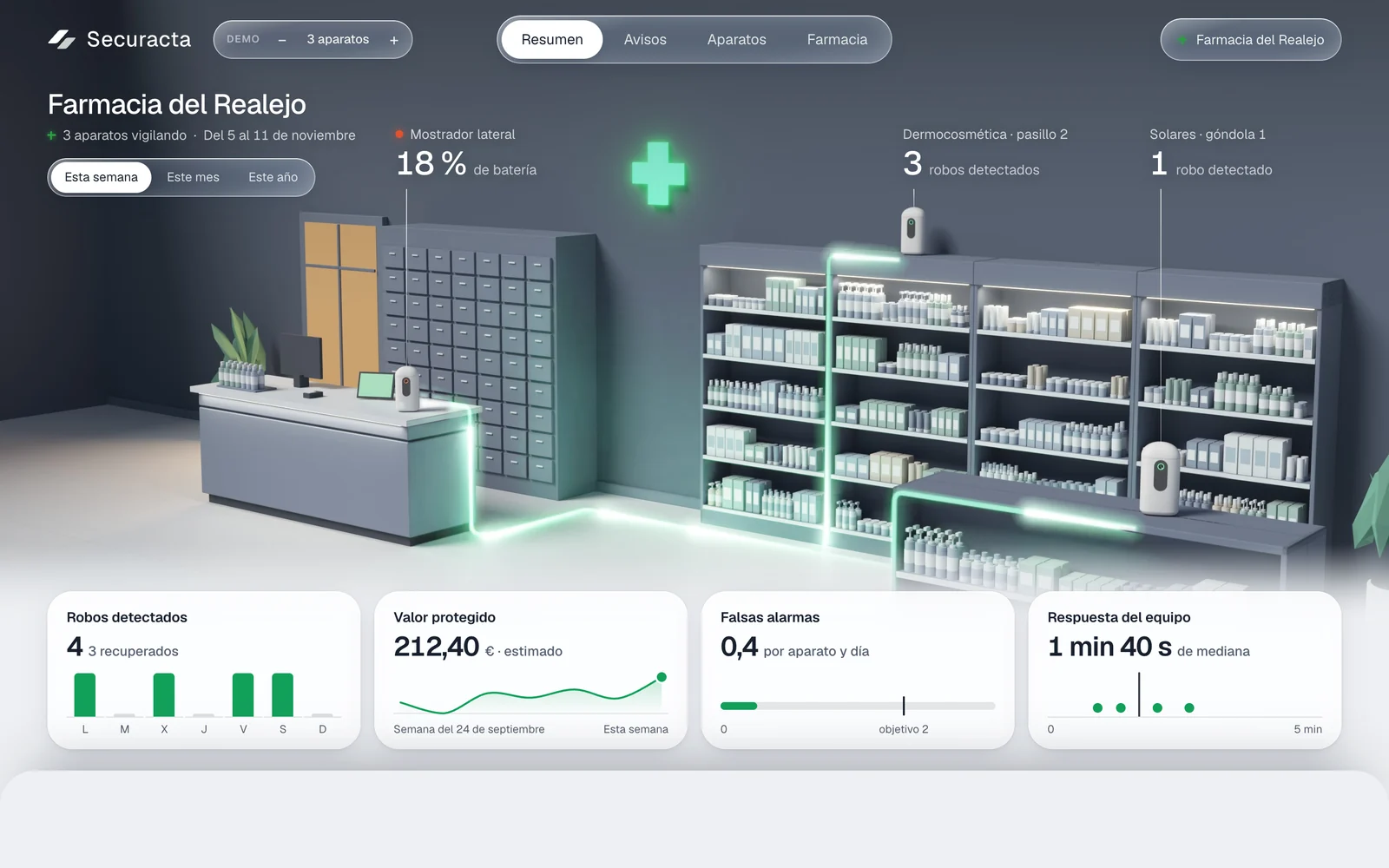
A device that detects shoplifting in pharmacies
Securacta’s web panel shows each device in its place with its alerts, currently on sample data because the product is in development. It is the same idea of an asset register by location with alerts. We do not yet have a published case of industrial preventive maintenance.
In development. The camera already recognises poses and the web panel runs on sample data; gesture detection is the next phase.
7Frequently asked questions
Can hours or cycles be read straight from the machine?
Sometimes. If the machine has a PLC or an accessible counter, it can be read automatically. If not, a weekly manual reading from a phone is enough, and the system flags it if someone skips it.
We have old machines with no documentation. Does it still work?
Yes. Their plan is built from your team’s experience and refined with the history.
Can we start with just some of the machines?
Yes, and we recommend it: the few that stop production when they fail. The rest join once the team has the habit.
Why not an off-the-shelf maintenance package?
If one fits, that is the sensible choice and we will say so. We build to measure when it needs to be joined to production, your stores or your management software in ways those packages do not cover.
Pick the machine that stopped you most this year
With its breakdown history and its manual we can show you what its preventive plan would look like and what data is missing to put it in place.
Tell us your problem