Matching supplier delivery notes and invoices without doing it by hand
Before paying a supplier invoice, someone should check that what is invoiced is what was ordered, at the agreed price, and what actually arrived. It is almost always done by hand, delivery note in one hand and invoice in the other. We build the system that checks them and shows you only what does not match.
1Three documents that should say the same thing
Three-way matching compares the order you placed, the delivery note for what was received and the invoice the supplier sends. If all three agree, the invoice can be approved. If not, there is a difference someone has to explain before paying.
Many small companies do not keep orders in any system, so the comparison is two-way: delivery note against invoice. That still works, and already catches most of the errors.
2The differences that keep coming up
When we review a month of purchase invoices with a company, almost always the same ones appear:
- A unit price different from the agreed one or the current price list.
- Quantities invoiced that never arrived, or arrived on another delivery note.
- The same delivery note invoiced twice, sometimes in different months.
- Credit notes for returns or breakages promised and never received.
- Carriage, surcharges or discounts that were not on the order.
3How we build it
First the documents need to be data, not paper or loose PDFs. Invoices and delivery notes arrive by email or are scanned; the system reads them, extracts each line and a person reviews anything unclear. If your supplier already sends structured e-invoices, even better: they are read directly.
Then comes the matching. Each invoice line is looked up in that supplier’s delivery notes by reference, quantity and date, and compared with the agreed price. What matches is marked; what does not goes to a list of differences with the amount at stake and the source document one click away. The reviewer decides: dispute, accept or wait for the credit note.
Finally, the approved invoice goes to accounts or to your management software, and the disputed one stays pending with its reason, so it is not paid out of habit.
4What this process is not
It is not bank reconciliation, which matches bank transactions with invoices already recorded; that has its own page. Nor is it just reading invoices: reading is the first step, and the value comes from checking against what was received. And it does not replace your accountant on how each difference is booked.
5What we have already built
Farmacta
A pharmacy’s back office, built on its paperwork
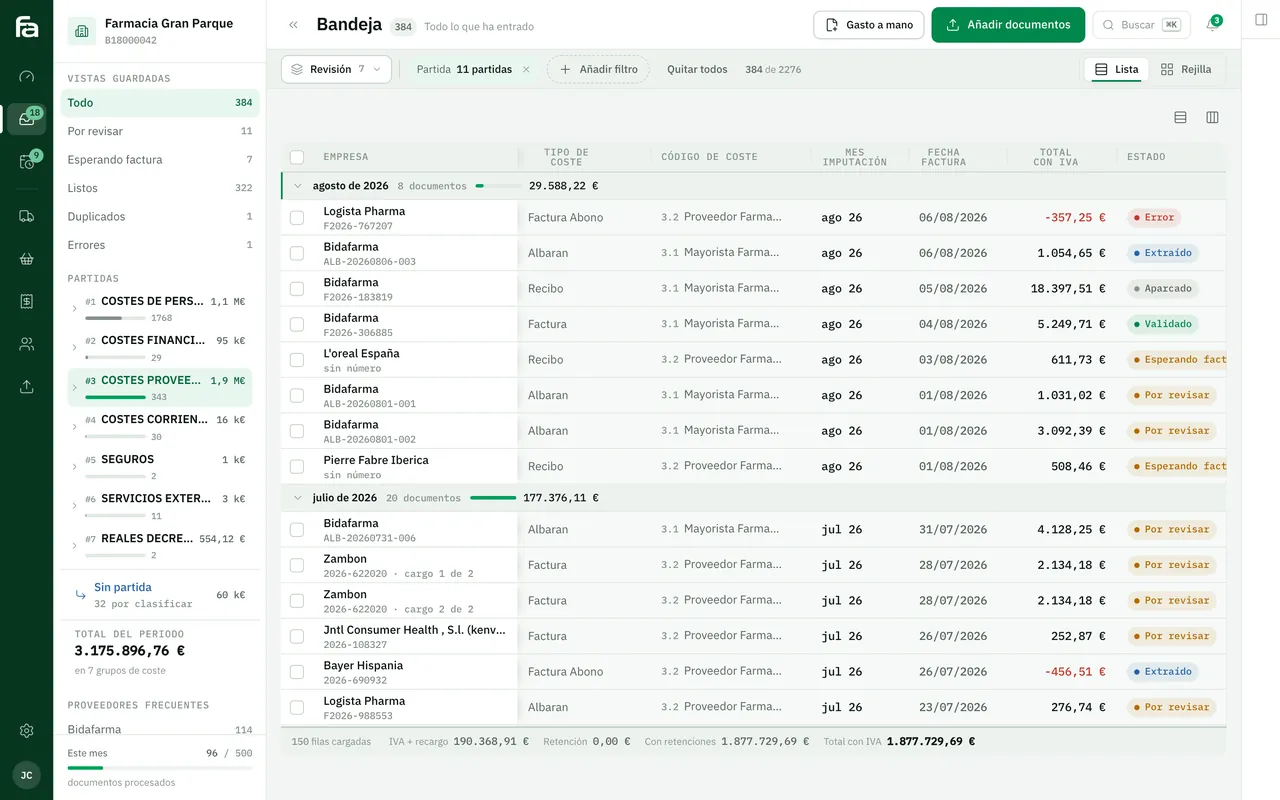
Farmacta does this work in a pharmacy: it reads the PDF delivery notes and invoices from wholesalers and laboratories, extracts the lines and gets them ready for review, and from there come due dates and cash flow. It is in use at its first pharmacy and was validated with more than 1,600 real documents from five years. Outside pharmacy we do not yet have a published case.
In use at its first pharmacy
6Frequently asked questions
Does it work if my suppliers send PDF invoices?
Yes. That is the most common case. The system reads the PDF and a person reviews uncertain fields. If a supplier sends structured e-invoices, those are used.
What if one delivery note is split across several invoices, or the other way round?
It is common and the matching allows for it: it works line by line rather than document by document, so one invoice can close several delivery notes and one delivery note can be spread over several invoices.
Do I need my orders in a system?
Not to begin with. Delivery note against invoice already catches the costliest errors. If you later record orders, the third check is added.
Does it work in any sector?
Yes, for any company that receives goods with a delivery note: distribution, bakeries, workshops, hospitality or construction. Pharmacy has its own page.
Send us a month of purchase invoices
With one supplier’s invoices and delivery notes for a month, we will tell you which differences appear and how they could be reviewed without doing it by hand.
Tell us your problem