Bank reconciliation: matching every transaction to its invoice without doing it by hand
Reconciling the bank means checking that every euro in or out of the account has an invoice, a receipt or an expense behind it. We build the system that makes the obvious matches on its own and leaves the doubtful ones to you, with the reason in plain view.
1The statement, the invoice list and a spreadsheet in between
In many small companies reconciliation happens at month end. Someone logs into each bank’s website, downloads the transactions as a spreadsheet or as a Norma 43 file (the standard Spanish bank statement format), exports the list of open sales and purchase invoices from the accounting software, and matches them in a colour-coded spreadsheet: green if it matches, yellow if it needs a look, red if nobody knows what it is.
With one account it takes an afternoon. With three banks, card payments and direct debits, it becomes days of work and a balance that never quite agrees.
2Why a transaction does not match first time
It is rarely because money is missing. It is because the bank and the books describe the same thing differently:
- A customer pays three invoices with one transfer, or one invoice in two payments.
- The amount arrives with a fee already deducted, or with an early-payment discount nobody recorded.
- The bank’s reference is truncated (“TRANSF. FROM CONSTRUC…”) and has no invoice number.
- A batch of direct debits arrives as a single credit and the returned debits come in one by one later.
- Card terminal settlements arrive grouped by day and net of fees.
- A payment has been made twice, or an advance has no invoice yet.
3Matching rules, from certain to doubtful
The system does not guess: it applies rules in order and says which one it used. First, exact amount and reference. Then amount, payer and a date close to the due date. Then it looks for combinations: which group of open invoices from the same customer adds up to what came in. Whatever is still unmatched stays open.
Your company’s own rules are written once and applied every time. For example:
- An account’s maintenance fee goes to bank charges without asking.
- A utility supplier’s debits are matched to that month’s invoice even if the amount differs by a few cents.
- A small difference between receipt and invoice is suggested as a fee or discount for someone to confirm.
- Returned debits from a batch are linked to the original direct debit and to the customer who needs chasing again.
4Open items and month-end close
What does not match does not vanish into a tab. It stays in a list of open items with its age, the person looking into it and what is known about it. The next month does not start from scratch, and anything open for weeks stands out.
At close, the system shows the bank balance, the book balance and the list of items that explain the difference. Confirmed matches go to your accounting software in whatever format it accepts, so nobody keys them in again. Matches the system suggests with doubts are not accepted until a person approves them, and every decision is recorded with its author and date.
5The closest thing we have built
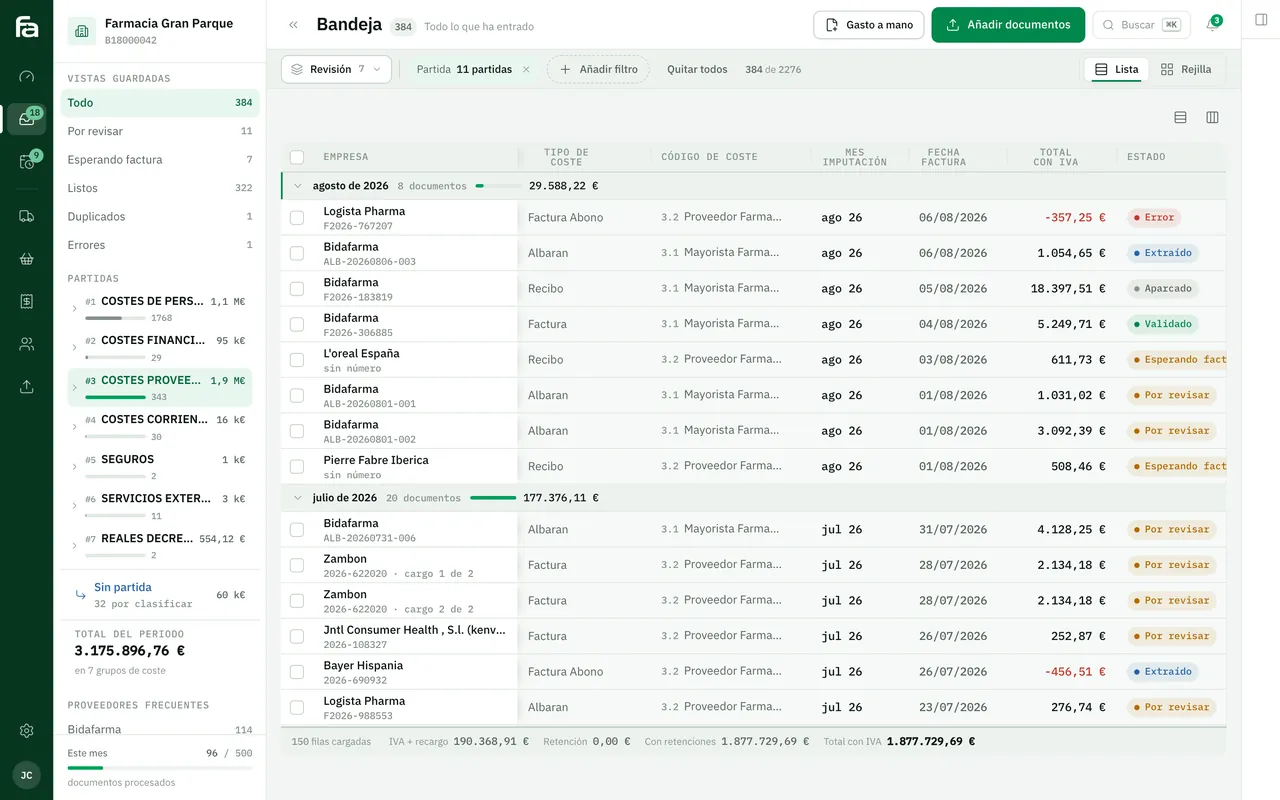
Farmacta
A pharmacy’s back office, built on its paperwork
Farmacta reads a pharmacy’s supplier delivery notes and invoices and derives due dates and cash flow from them. It does not read bank statements: bank reconciliation would be the next piece on top of that same data. We do not yet have a published bank reconciliation case.
In use at its first pharmacy
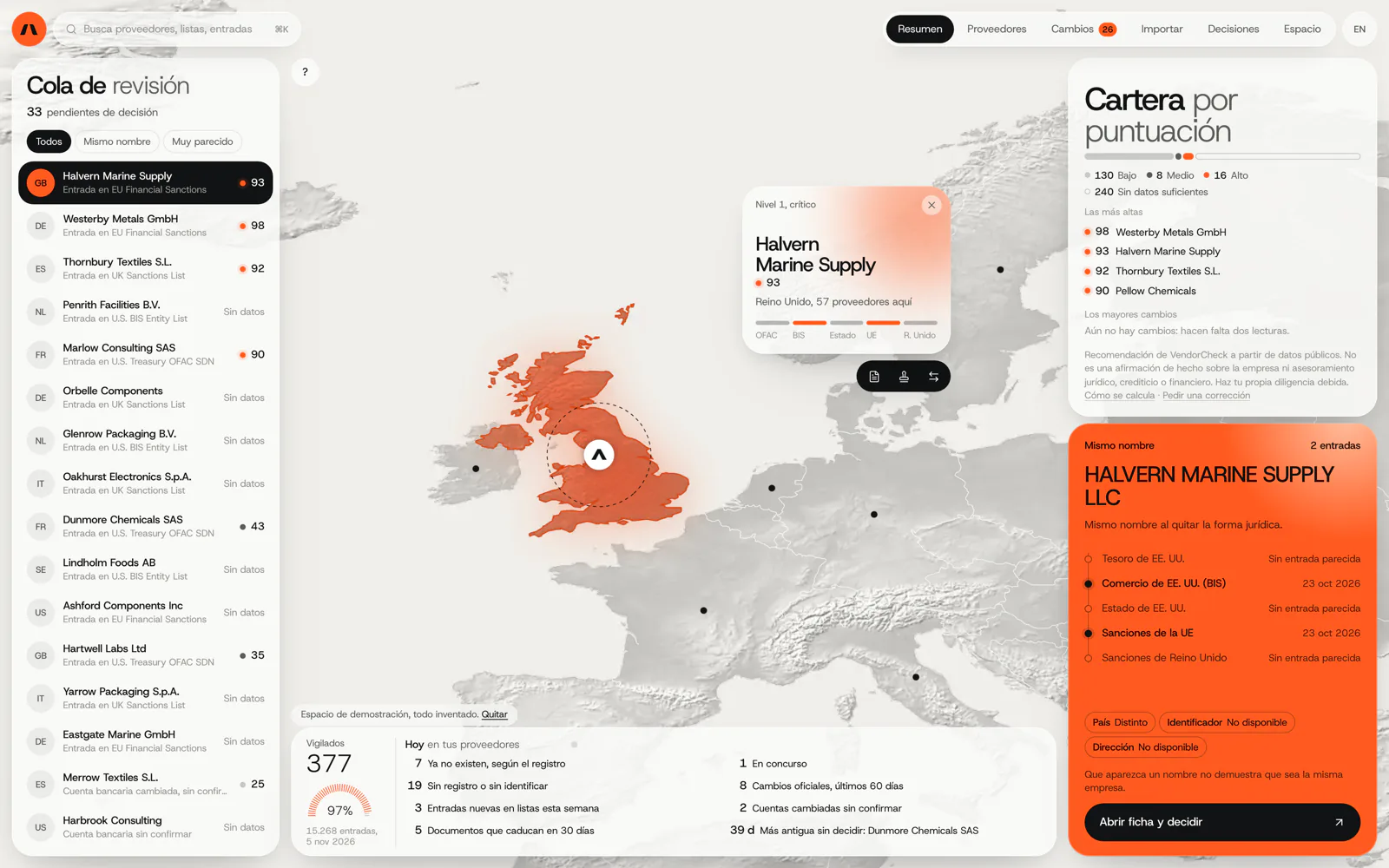
VendorCheck
Supplier screening against official sanctions lists
VendorCheck shows why a name resembles an entry on an official list and lets a person decide, with source and date recorded. A doubtful match between a receipt and an invoice calls for exactly that treatment. It is in development.
In development. Matching against the official lists works; accounts, billing and alerts are coded and not yet connected. The screens are shown with an invented demo workspace.
6Frequently asked questions
How do bank transactions get into the system?
The simplest route is the transaction file almost every Spanish bank lets you download in Norma 43 format. Authorised account aggregation services, which read your accounts with your consent, are another option. We choose with you based on your banks and how much you want to automate.
Do I have to give you my online banking passwords?
No. We do not store banking credentials. If an aggregator is used, you grant the authorisation directly with your bank and can withdraw it whenever you like.
What about direct debit batches and returns?
They are linked to the individual debits in the batch. When a return arrives, the system ties it to the debit and the customer and flags it for collection.
My accounting software already reconciles. Why something else?
If what it does is enough, keep it. What we build makes sense when your rules are unusual, you work with several banks or companies, or you need to match against data the accounting software does not hold, such as orders or card settlements.
Does it work for several companies in the same group?
Yes. Each company has its own accounts and rules, and the open items of all of them can be viewed together.
Bring us the statement from a difficult month
With one real month of transactions and your invoice list, we can tell you how many would match on their own and what rules the rest would need.
Tell us your problem